
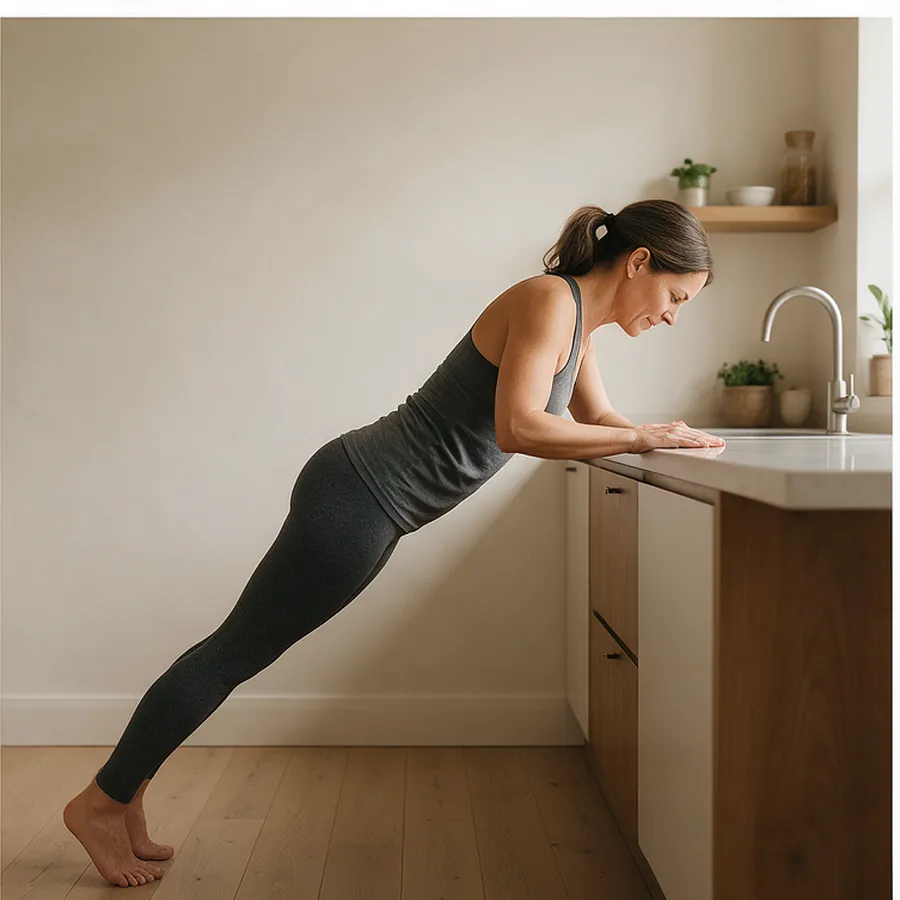
No equipment means no excuse and no delay: a hotel room, a kitchen, a lunch break at the office. This session uses the floor, a wall and a counter to load the same patterns the dumbbell session does, and it is the one to learn first if lifting feels like a different world. Five moves, two rounds, ten minutes, and a way to make each move harder when it stops being hard.
The session
| Minute | Move | Reps | Notes |
|---|---|---|---|
| 0:00 to 1:30 | Warm-up: arm circles, 10 marching steps on the spot with high knees, 5 cat-cows | ||
| 1:30 to 5:15 | Round one: bodyweight squat, incline push-up, glute bridge, bird-dog | 12, 10, 12, 6 each side | Straight from one to the next |
| 5:15 to 6:00 | Wall sit, 30 to 45 seconds, then rest the remainder | Thighs toward parallel, back flat on the wall | |
| 6:00 to 9:30 | Round two: the same four moves | 12, 8 to 10, 12, 6 each side | Slower on the way down this round |
| 9:30 to 10:00 | Finish: walk, one hip flexor stretch each side |
The moves
1. Bodyweight squat
Feet a little wider than hips, toes slightly out, arms forward for balance. Sit down between the heels, chest up, knees tracking over the toes, to parallel or as deep as the heels stay flat. Stand by pushing the floor away. Three seconds down, one second up.
Harder: pause for two seconds at the bottom; then hold a filled rucksack against the chest; then the single-leg version to a chair.
The first fault: the knees caving inward. Push them out over the little toes and slow the descent.
2. Incline push-up
Hands on a sturdy counter, bench or the back of a sofa, a little wider than shoulders, body in one straight line from head to heels, feet back far enough that the arms are vertical at the top. Lower the chest to the edge, elbows at about 45 degrees to the body, then press back up. The higher the hands, the easier; the floor is the end of the progression, not the start.
Harder: lower the hands to a chair seat; then a step; then the floor with knees down; then the floor.
The first fault: the hips sagging or lifting. Squeeze the glutes and brace the trunk so the line stays straight; if it will not, raise the hands.
3. Glute bridge
On the back, knees bent, feet flat and hip-width, heels close enough to touch with the fingertips. Push through the heels to lift the hips until the body is a straight line from knees to shoulders, squeeze the glutes at the top for one second, lower slowly.
Harder: pause three seconds at the top; then one foot off the floor, the single-leg bridge.
The first fault: arching the lower back at the top to go higher. Stop at the straight line; the lift comes from the glutes, not the spine.
4. Bird-dog
On hands and knees, wrists under shoulders, knees under hips, back flat. Reach one arm forward and the opposite leg back until both are level with the torso, hold two seconds without the hips twisting, return, and switch. Six each side, slowly.
Harder: hold five seconds; then hover the knee and the hand a few centimetres off the floor between reps.
The first fault: lifting the leg so high the back arches and the hips open. Lower is better; level with the body is the target.
5. Wall sit
Back flat against a wall, feet out in front, slide down until the thighs are near parallel and the knees are over the ankles. Hold. Breathe. Thirty seconds the first week, forty-five by the fourth.
Harder: lift the heels; then one foot a few centimetres off the floor for ten seconds at a time.
The first fault: knees drifting forward past the toes. Walk the feet out until the shins are vertical.
Making it harder without equipment
Bodyweight work progresses by leverage and tempo, not by plates. The order for each move is above; the rule for moving up is that two rounds at the current level feel comfortable for two sessions in a row. Slowing the lowering phase to four seconds is the quickest way to make any of these hard again. A filled rucksack held to the chest turns the squat and the bridge into loaded moves and costs nothing.
Two or three sessions a week with a day between is the pattern in the trials the Westcott review covered, where ten weeks of resistance training added about 1.4 kg of lean weight in adults. The sessions in those studies were longer and used weights; this session builds the habit, teaches the patterns and keeps strength in a week away from home. It does not promise fat loss or a body shape, and ten minutes is a floor, not a ceiling. When the floor push-up arrives, the dumbbell session is the next step.
A week of it, written out
| Day | Session | Minutes |
|---|---|---|
| Monday | This session, round one at the current level, round two slower | 10 |
| Tuesday | A brisk walk, or the stretch routine | 10 to 20 |
| Wednesday | This session, the next progression on one move only | 10 |
| Thursday | Walk | 10 to 20 |
| Friday | This session, with the wall sit at 45 seconds | 10 |
| Weekend | One longer walk, one rest day |
Three strength days, two walking days, one rest. Progress one move at a time: the week the incline push-up moves from counter to chair, the squat and the bridge stay where they were. Changing everything at once is how a session goes from comfortable to impossible in one step and gets abandoned.
The five patterns, and why these moves
Every strength session on this site touches the same patterns: squat, hinge, push, pull and a brace. Here the squat is the squat, the glute bridge is the hinge turned on its back, the incline push-up is the push, the bird-dog is the brace and, with the arm reach, a slow pull of the shoulder blade, and the wall sit is the leg endurance that stairs and hills ask for. There is no pull with a weight because there is no weight; a towel looped round a door handle for a row is the first thing to add when one is wanted, and the dumbbell session has the real one.
What the research says
- Westcott, Current Sports Medicine Reports, 2012, narrative review of resistance training in adults, 2 to 3 sessions a week over 10 weeks and longer: lean weight up about 1.4 kg, resting metabolic rate up about 7 percent and fat weight down about 1.8 kg over ten weeks. The contrary finding: a mixed review, longer sessions with weights, and effects that varied with age and starting fitness. doi.org/10.1249/JSR.0b013e31825dabb8
- Bull and colleagues, British Journal of Sports Medicine, 2020, the WHO 2020 physical activity guidelines for adults: muscle-strengthening activity on 2 or more days a week, 150 to 300 minutes of moderate activity, and the removal of the 10-minute minimum bout because activity of any length counts. The contrary finding: a guideline rather than a trial of short sessions. doi.org/10.1136/bjsports-2020-102955
- Stamatakis and colleagues, Nature Medicine, 2022, prospective cohort of 25,241 UK Biobank adults, mean age 62, who did no leisure-time exercise, over a median 6.9 years: 3 to 4 short daily bouts of about one minute of vigorous everyday activity were associated with 38 to 40 percent lower all-cause mortality. The contrary finding: observational data, and bouts of everyday activity rather than workouts. doi.org/10.1038/s41591-022-02100-x
Questions people ask
My wrists hurt in the push-up. Turn the hands out slightly, or hold the edge of the counter rather than placing the palms flat; if it continues, use fists on a folded towel.
Is this enough to build muscle? It is enough to start, to learn and to keep what you have. Building beyond that needs the progressions above and, eventually, something heavier than your body; the trials that measured muscle gain used weights.
Can I do it in the morning before coffee? Yes; the warm-up is there for exactly that. Slower on round one, a glass of water first.
What about my knees? Squat to the depth that is comfortable and keep the knees tracking over the toes; a chair behind you to sit to and stand from is a fine version. Knee pain that persists is a reason to see a physiotherapist before loading it.